The AI LMS where teaching, assessment and marking finally connect.

Remedia links your learning objectives, courses, assessments, AI pre-marking and learner insights in one workflow. AI does the first pass. Your teachers make every final call.

Class NameOrganizationLearning unitsLearning unitsAssignmentAssignmentRubricRubricSubmissionsSubmissionsOlivia RhyeTeacherAssignmentFilterSearchNew AssignmentAssignment titleFormatSubjectGradeCreatedPrice elasticity of demandEssayEconomicsYear 1211/05/2026EditSupply and demandMultiple choiceEconomicsYear 1211/04/2026EditMarket structuresEssayEconomicsYear 1211/02/2026EditConsumer choice and utilityShort answerEconomicsYear 1210/30/2026EditCosts of productionMultiple choiceEconomicsYear 1210/28/2026EditMacroeconomic indicatorsEssayEconomicsYear 1210/24/2026EditFiscal and monetary policyShort answerEconomicsYear 1210/21/2026EditShowing 1–7 of 24 results1234Learning unitsNew learning unitSearch…PublishedPrice elasticity of demand:concepts, measurement, useIntroduce how quantity demanded respondsto price changes, the elasticity formulaand its effect on total revenue. Case study…Sections05Start date2026-10-28End date2026-11-300/0 Assignments completedPublishedSupply, demand andmarket equilibriumExplain how markets reach equilibrium,what shifts curves and how price controlsaffect outcomes. Short applied examples…Sections05Start date2026-10-28End date2026-11-300/0 Assignments completedPublishedMarket structures: competition,monopoly and oligopolyCompare the main market structures,their pricing power and what each meansfor consumers and for regulators…Sections04Start date2026-10-26End date2026-11-300/0 Assignments completedPublishedCosts of production andfirm decisionsCover fixed and variable costs, marginalcost and how firms decide how much toproduce in the short and long run…Sections05Start date2026-10-26End date2026-11-300/0 Assignments completedPublishedMacroeconomic indicators:growth, inflation, jobsPresent the key indicators used to read aneconomy, how they are measured and howto interpret them together…Sections04Start date2026-10-26End date2026-11-300/0 Assignments completedPublishedFiscal and monetary policyin practiceExamine how governments and central bankssteer demand, with a worked case on adownturn and the trade-offs involved…Sections03Start date2026-10-26End date2026-11-270/0 Assignments completedRubricLibraryNew rubricStandard rubrics10Multiple rubricsRubric titleFormatStatusPointsElasticity of demandShort answerTableCreated3Calculating elasticityShort answerTableCreated4Revenue and elasticity essayLong answerTableCreated10Market structuresShort answerTableCreated4Fiscal and monetary policyLong answerTableCreated10Student submissionsSearchFilterAllTeacher-ledMonitoredSelf-studyAssignment titleFormatStart dateDue datePrice elasticity of demandQuestionnaire2026-11-02 09:002026-11-20 09:0012Supply and demandQuestionnaire2026-10-28 14:302026-11-12 14:305Market structuresQuestionnaire2026-10-21 16:202026-10-30 16:208Costs of productionQuestionnaire2026-10-14 10:002026-10-28 10:003Showing 1–4 of 4 entries1

Stop juggling tools.
Start improving learning.

Connected outcomes

Objectives, courses and assessments stay aligned in one place — no more scattered files.

Educators in control

Educators, learners and AI-assisted drafts work together, with people making every final call.

Criteria-led marking

Your rubric guides pre-marking. You review each suggestion before anything is released.

MarkingEducator in control

AI marking that your teachers actually trust.

Remedia pre-marks each response against your rubric: level, score and written feedback, criterion by criterion. Teachers see the student's answer next to the suggestion, change anything they disagree with and approve. In teacher-led mode, nothing reaches students until a teacher says so.

  • Criterion-level scores and feedback, fully editable
  • Anonymous marking to reduce bias
  • Adjustable strictness, from encouraging to exam-strict
  • Students get an email as soon as their work is marked
Explore AI marking
MStudent answersLearner 12Learner 13Total score8 / 129 / 12Question 01Multiple choiceDemand is elastic when…A. price rises and revenue risesB. quantity falls more than price risesC. buyers ignore price changes2/33/3MarksCorrect answerABCJustificationCorrect choice. Explain the revenue effectto earn the full justification mark.Question 02Short answerExplain how elasticity affects total revenue.Revenue falls when price rises because buyerscut back more than proportionally, so a firmfacing elastic demand should avoid price rises.Marks are suggested from your rubric.RubricOrganisation2/3Clarity2/3Critical thinking2/3Grading progress18 of 25 submissions marked19 of 25 submissions markedNext learner →
SessionsPaper or screen

On screen, in class, under exam conditions, or on paper.

Run every assessment the way your context needs: self-study practice with an AI tutor that gives hints, not answers; teacher-led assignments; monitored tests with timer, soft lockdown and tab-switch detection; or paper exams, where one scanned PDF is split and matched to every student automatically.

See the four session modes
MMonitored assessmentMonitoredAssessment controlsAttempts1 allowedTime limit45 minutesBehaviour flagsTime left44:5842:3140:1238:05Live monitoringFlags are prompts for educator reviewLearnerTimeFlagL11Learner 1121:04L12Learner 1218:21Pasted textReviewedL13Learner 1324:40L14Learner 1419:57Left tab ×2L15Learner 1526:12Learner 12 · Pasted text18:21 · 240 characters pasted into question 2.Interpret this flag with your institutional policy.DismissReview responseEducators interpret flags and apply institutional policies.
CreationYour materials, your standards

Build courses and assessments in minutes, from what you already have.

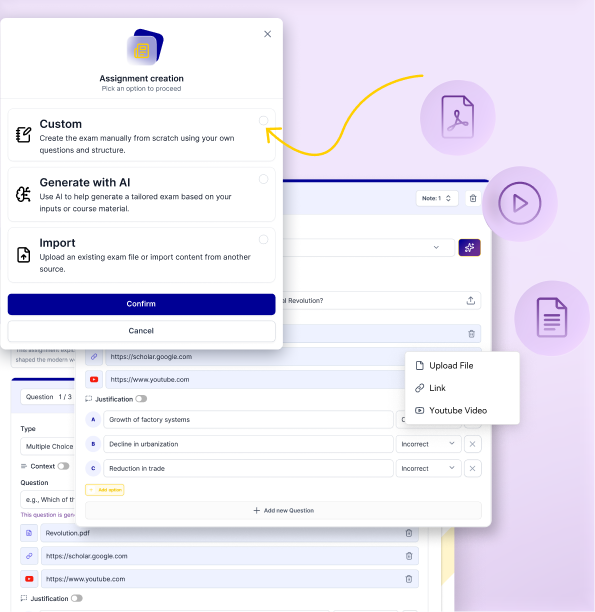
Upload lesson notes, slides, spreadsheets, PDFs, audio or a YouTube link. Remedia proposes learning objectives, a course structure or a full assessment with questions and rubric, aligned to your curriculum standards. Every draft is checked by an independent AI reviewer, and you edit every line before it reaches students.

  • Learning objectives and Bloom levels on every question
  • Difficulty from 1 to 5, set by the teacher
  • Facts cross-checked by a second AI model
Explore AI course creation
MNew AssignmentAIAssignment infoAdd basic assignment details.Assignment infoAdd basic assignment details.Generated StructureCheck and edit generated content.Generated StructureCheck and edit generated content.SettingsConfigure preferences.Assignment TitlePrice elasticity of demandDue DateJan 6, 2026 · 00:30Define the topic and what you expect students to achieve.Students analyse how a change in price affects demand and revenue.FormatEssay1Multiple choice1Short answer1Context fileUpload supporting material (lesson notes, articles or resources) to guide the AI.Click to uploadnotes.pdf200 KBGenerate Learning OutcomesGenerating…Learning objectiveAdjust the objectives manually or select ‘Regenerate’ for a new set.Students will be able to define price elasticity of demand.Students will be able to calculate elasticity from a demand schedule.Students will be able to explain how elasticity affects total revenue.Students will be able to compare elastic and inelastic goods.Add a Learning objectiveRegenerate objectivesGenerate a structureSections summaryStructure generated in 4 sections. Rearrange, modify or delete before generating the content.1Foundations of elasticityDefining price elasticity of demand and how it is measured.2Calculating elasticityWorking with demand schedules and the percentage-change formula.3Elasticity and total revenueHow price changes affect revenue for elastic and inelastic goods.4Elastic and inelastic goodsComparing substitutes, necessity and time as determinants.BackValidate and generate content
How it works

Turn complex teaching workflows into simple steps.

Three steps from learning objectives to reviewed feedback and insight.

Step 1

Design your outcomes

Define objectives, blueprint the assessment, then build content manually, by import or with AI-assisted drafts.

Step 2

Deliver and pre-mark

Run it as self-study, teacher-led, monitored or on paper, and let your rubric guide AI pre-marking.

Step 3

Review and improve

Review marks, release feedback and use class insights to plan revision and follow-up.

One workspace for every assignment.

Create, review and track assessments from a single interface — built around your learning outcomes and marking criteria.

MNew AssignmentAIAssignment infoAdd basic assignment details.Add questionsAdd questions and instructions.SettingsConfigure preferences.Question 1 / 3Note: 1TypeMultiple ChoiceQuestionWhich of the following best describes elastic demand?This question is generated with AI.AQuantity demanded changes more than priceCorrectBQuantity demanded barely changesIncorrectCPrice has no effect on revenueIncorrect+ Add option← PreviousPreviewNext →
Remedia platform · illustration with demo data

One assessment, four ways to run it.

Self-study, teacher-led, monitored or on paper. Every mode stays tied to the same objectives, rubric and insights.

MClass activityTeacher-ledEconomics 1 · Price elasticity5 learnersL11Learner 11WorkingSubmittedL12Learner 12WorkingSubmittedReleasedL13Learner 13WorkingSubmittedL14Learner 14WorkingSubmittedL15Learner 15WorkingSubmittedSelect a submission to review.Review · Learner 12Learner responseRevenue falls when price rises because buyerscut back more than proportionally, so a firmfacing elastic demand should avoid price rises.Suggested 2/3Your mark2/33/3AdjustedFeedbackGood use of the formula. Add a worked exampleto justify the revenue effect.Approve & releaseHoldMarks released to Learner 12Final outcome decided by the educatorEducators review responses, adjust suggested marking and decide the final outcome.0 of 5 released1 of 5 released
Remedia platform · illustration with demo data
Product walkthrough · assignment creation
See it in actionAssignment creation

Watch an assignment come together, from objectives to questions.

Explore AI course creation
FAQ

Questions institutions ask first.

Here’s what most teams want to know before a first walkthrough.

Still have questions?

Contact us and we’ll help you out.

Does Remedia replace teachers' marking?

No. Remedia pre-marks each response against your rubric and suggests feedback for every criterion. In teacher-led mode, teachers review, adjust and approve every mark before students see it.

Can Remedia mark handwritten or paper exams?

Yes. Print a QR-coded cover sheet for each student, scan all scripts into one PDF, and Remedia splits the file and matches each script to the right student. Students can also upload photos of handwritten work, which is converted to text with OCR.

How is Remedia different from using ChatGPT or another chatbot?

A chatbot gives you text to copy and paste. Remedia generates courses, assessments and rubrics inside a teaching workflow, linked to your objectives, standards and students. An independent AI reviews and fact-checks the content, and the result goes straight into marking and insights.

Does Remedia work with our LMS?

Yes. Remedia connects to LTI-compliant LMSs such as Moodle, Canvas, Blackboard and Brightspace, imports SCORM packages, supports single sign-on with Google and Microsoft, and imports assignments, rubrics and students from Google Classroom.

Can I try Remedia for free?

Yes. Anyone, whether a teacher, lecturer, trainer or school team, can start a free trial with no commitment. Schools and universities then move to an institutional plan.

See Remedia with one of your own assessments.

In 30 minutes we follow a real assignment from your subject, from rubric to approved mark to class insight.

Book a Demo